Saturday, February 14, 2009

Near Stono

A stone pillar and walls near Turman House (also known as Stono) at the Virginia Military Institute.

This part of the VMI Post is like a trip back in time. You can walk an abandoned road up from the far north end of Main St., to a small lane along the side of the hill above Jordan's Point. From there, among the handsome 19th C. houses, it is not hard to imagine that it is 150 years ago, if you train your eyes to the right views.

Friday, February 13, 2009

All-American

The American flag flies over the door of an 1857 brick Federal style house on South Main St.

A truly American scene (as was yesterday's post, come to think of it). It's for sale, too -- it can be yours for $1.05M.

Thursday, February 12, 2009

Football on the lawn

Tossing a football on the lawn between Doremus Gymnasium and Elrod Commons on the campus of Washington and Lee.

I took this picture a little while ago, but it's appropriate for the sort of weather we've had the last few days, as well. Last week: snow; this week: temperatures near 70° F (21° C).

Wednesday, February 11, 2009

From tiny acorns...

Iron oak leaves embrace the acorn logo of J.F. Brown Real Estate on Washington St.

This beautiful and imaginative sign went up a couple of years ago, and really raised the bar for business signs in Lexington, I think.

I became aware of the advantage to a town of a talented sign maker when we bought our first house (in New Hampshire, fifteen years ago) from a young man who had been running his sign making business from a shop on the property. (He also had built the house and shop himself.) We soon noticed that many of the best signs springing up in the nearby town of Keene were his. Today, he can walk down Keene's Main St. - and many another street - and see his work on all sides. His signs have contributed significantly to the distinctive character of the place. (If you're curious, you can see some of them here.)

Lexington clearly has access to talented sign makers, too, and when I find out who made the one above - perhaps one of the local blacksmiths? - I'll update.

Tuesday, February 10, 2009

Red bollard

A red bollard (one of a row along the street) and a modern sculpture in a front garden on Stonewall St.

I'm impressed by the marvelous color of these bollards, punctuating a wide bed of liriope between the lawn and the street. I'm not sure what I think of the sculpture though. What do you think it is?

Monday, February 9, 2009

Blue and gold II

The "carpenter Gothic" central gable of the St. Patrick's parsonage.

Built in 1840, the painted brick parsonage predates the church it serves by 113 years. It's possible there was another church on the site before the present one, but I haven't yet found evidence of it. (A small church on Henry St. - now the Gospel Way Church of God - is referred to as "Old St. Patrick's," which suggests that the congregation moved here from there at some point.) It seems likely that this was originally a private residence adapted by St. Patrick's for its purposes.

Whatever its history, the parsonage has charm. Here it is, tucked beside and behind the more modern stone church:

Sunday, February 8, 2009

Church on Sunday: St. Patrick's

An image of Saint Patrick before the Catholic church bearing his name on Nelson St.

Lexington's sole Catholic church is St. Patrick's, built in 1953. (Like much of the valley, this area was settled by the Scots-Irish; as a result, Protestant churches - particularly Presbyterian - are much more numerous than Catholic.) The parsonage that adjoins the church is much older than the church itself, having been built in the Gothic Revival style in 1840. A glimpse of that tomorrow.

Saturday, February 7, 2009

A more recent past

The neon sign for the Southern Inn on Main St.

Much of Lexington brings to mind past eras: the Colonial, Antebellum, Civil War and post war periods in particular. This well-known sign in the center of town is a relic from a more recent past. The Southern Inn restaurant is celebrating 75 years in business this year. That would date it to 1934, and the sign looks to be of that vintage, as well. You can tell how proud the business is of it by how prominently it is featured on their website.

Lexington's sign ordinance would not allow this sign to be installed today, which I think on the whole is a good thing. One such in a town this size is enough. But it does make an interesting contrast to the 18th and 19th century history that dominates here.

Friday, February 6, 2009

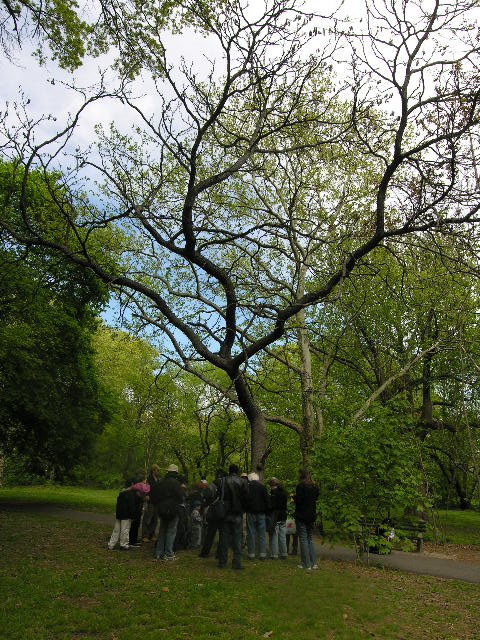
Kentucky Coffee tree

A Kentucky Coffee tree against the sky, above a lilac bush heavily laden with snow.

I'm very attached to this tree, though it's not mine (or ours), but our neighbors', as it is growing in their backyard, and only generously spreads its branches and roots over our way. Our neighbors (who are most excellent neighbors) take particular care of this beauty, which is spectacular in every season, but perhaps especially so in winter.

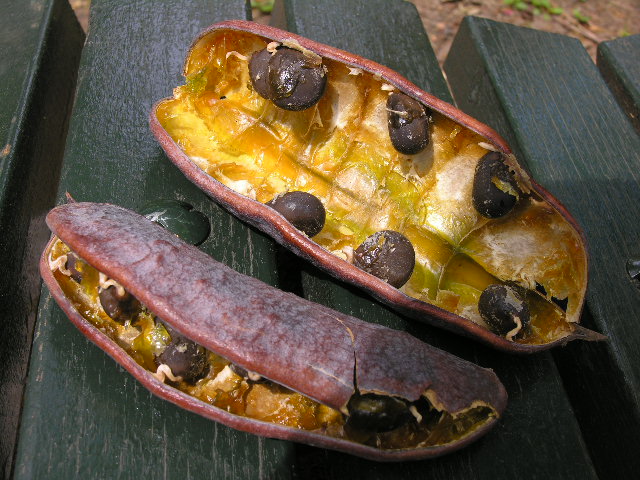
This uncommon tree (Gymnocladus dioicus) was first encountered by Europeans in Kentucky, but it appears from Canada to Louisiana. It is said that early settlers broke open the distinctive seedpods and used the roasted seeds to make a substitute for coffee. The seeds do smell a little like coffee, and they contain a nicotine-like substance that can be fatal in high doses. The tree's roots will compete successfully with the lawn, it drops pods and twigs all over the place from fall to spring, and the tiny leaflets (on compound leaves similar to the Honey Locust) are so small that they slip between the tines of any rake. But these nuisances pale in relation to its gifts: broad, dappled summer shade and a striking winter silhouette.

I've tried in vain for several months to take a photo that captures the many attractions of this species of tree: the stately height; the rugged bark; the fascinating and vigorous branching habit; the purplish, dangling seedpods; and particularly, the levels of scale that exist in angular progression from the thick trunk out to the super-numerous delicate twigs.

But what the eye can take in at one glance, the camera (or, at least, my camera) can not. So here's another shot, showing the seedpods against the twilight:

Thursday, February 5, 2009

Blue and gold

Hay bales off Route 11 several miles north of town.

The invention of the round hay-baler was a boon for lovers of the picturesque.

Wednesday, February 4, 2009

White on white

White house, white picket fence, and snow.

We finally got a snow that stuck, though only an inch or two, and very wet, at that. The beauty of wet snow is that it sticks to everything -- though you need to be quick, in this climate, to enjoy it.

I had promised some morning light in January, and failed. Here's a little, four days late.

Tuesday, February 3, 2009

Lowering the streets

The Alexander-Withrow Building at Washington and Main, seen from the steps of the old courthouse.

The building at left was one of two to survive the fire of 1796. (I posted earlier about it, here.) From the old courthouse steps you get a good view of the exposed foundation, which is part of one of the more unusual stories in Lexington history.

Prior to 1851, the streets leading to the center of town were so steep that at times, particularly in wet weather, it was difficult for heavily-laden horse-drawn vehicles to make the climb. The townspeople decided the lower the grade - most markedly in the area shown above - at great difficulty and expense. The Alexander-Withrow Building gained an entire story that had been below grade, as did several other buildings. Structures in the vicinity built before 1851 show the evidence of the street-lowering, including the Dold Building across the street.

Not a few Main St. residences ended up with their front doors five or six feet off the sidewalk! (I'll show you how they adjusted to that in an upcoming post.)

Monday, February 2, 2009

Second place

A steel walkway bolted to the north side of the Nelson Street bridge over Woods Creek, shot from below.

This was my second choice (albeit a distant second) for yesterday's "paths and passages" theme. I may be alone in my interest in the underside of this bridge (I posted earlier about it, here), though many Lexingtonians pass below it every day while walking or running on the Woods Creek Trail.

In the future, I plan to post the interesting underside of some other bridges (for instance, the I-81 overpass on the Chessie Trail), so bear with me. Sometimes I like to look up.

Sunday, February 1, 2009

Theme Day Feb 2009: Paths and Passages

Jackson Arch, entrance to the Barracks, Virginia Military Institute, taken from beside the pedestal of Moses Ezekiel's Stonewall Jackson.

Today is the first of the month, the day that city daily photo bloggers from around the world post on a single theme. February's theme is "paths and passages."

One of the most significant passages we have in Lexington is Jackson Arch, through which pass, each fall, new VMI cadets to begin their four years of rigorous physical and mental training. First year cadets, nicknamed "rats" since the 1850's, will endure for the entire year a demanding system of initiation known as the "ratline." The VMI website states: "The system is designed to remove wealth and former station in life as factors in one's standing as a cadet, ensuring equal opportunity for all to advance by personal effort, and to enjoy those rewards that are earned."

Upon entering the first day through Jackson Arch, each cadet will see the words of Stonewall Jackson inscribed within: "You may be whatever you resolve to be."

To see the paths and passages of other bloggers, click here to view thumbnails for all participants.